
The Armory Show 2026: What This Year’s Fair Tells Us About the Market
Updated: Sep 28
The Armory Show returned to the Javits Center from September 24–27, 2026, opening New York’s fall art season with more than 230 galleries and a broad mix of modern and contemporary art. The 32nd edition also arrived more than two weeks later than its traditional early-September dates, placing the fair deeper into the city’s fall cultural calendar.

Cecily Brown
The 5 Senses (blue and indigo), 2026 7 color silkscreen
35 x 49 in Edition of 10
Two Palms Gallery (Booth 211)
For collectors, several developments were particularly worth watching.
More Space for Emerging Galleries
One of the good developments at the 2026 edition was the expanded presence of younger galleries.
The Presents section, dedicated to galleries founded within the past 12 years and centered on solo and dual-artist presentations, grew by approximately 20% compared with 2025. Alongside it, Solo offered focused presentations of individual emerging, established and historical artists, allowing visitors to engage more deeply with a single practice rather than encounter it as one work among many.
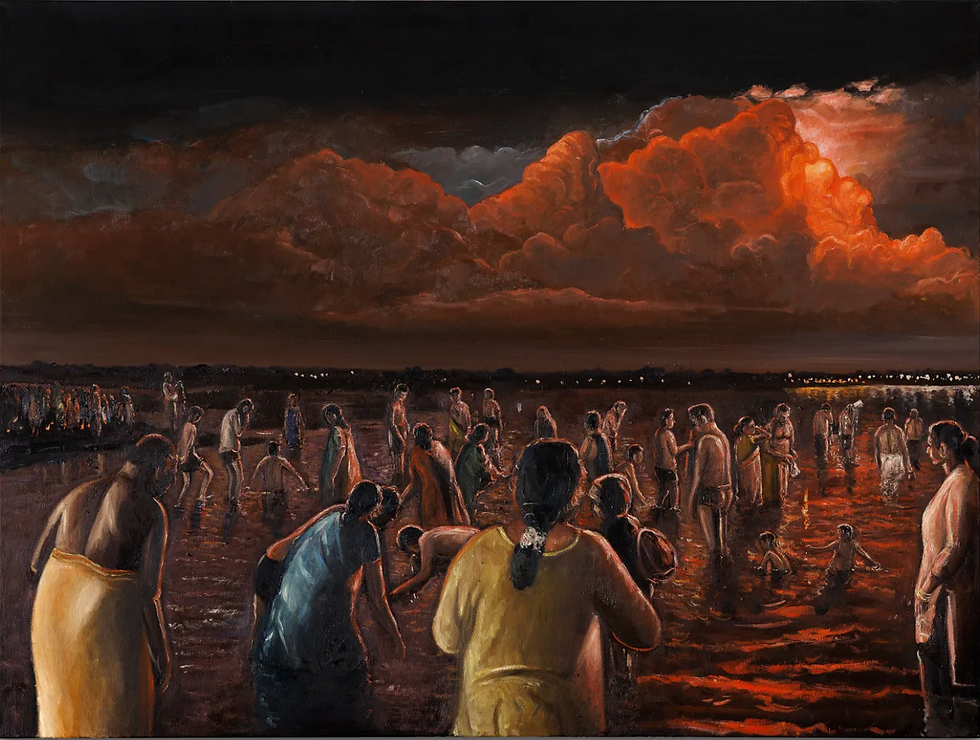
Raghav Babbar SWARG (Maha kumbh), 2026 Oil on canvas 30 x 40 in, 76.2 x 101.6 cm
Rajiv Menon Contemporary
(Booth P44)
One example was Rajiv Menon Contemporary, a first-time Armory Show exhibitor presenting Raghav Babbar in the expanded Presents section. Babbar's new paintings, inspired by his experience at the 2025 Maha Kumbh pilgrimage in India, ranged from works on paper at $7,000 to paintings in the mid-five figures. By the first hours of the VIP preview, all of the paintings had sold, illustrating both the opportunities and the level of collector interest that the fair can generate for younger galleries.
The expansion is particularly relevant in the context of today's market. While established names continue to provide an important foundation for major fairs, discovery remains one of the principal reasons collectors attend them. Younger galleries can offer access to artists at earlier stages of their markets, while concentrated presentations provide more context for understanding a practice before making an acquisition.
At the same time, participation presents a significant financial calculation for galleries. Dealers interviewed by The Art Newspaper described the potential rewards of exposure and new collector relationships alongside the substantial costs of exhibiting, with some sharing booths or pursuing other strategies to reduce expenses.
That tension between the cost of participating and the importance of being physically present extends well beyond The Armory Show.
Why Art Fairs Still Matter
The wider market provides useful context for understanding the importance of this year's fair.
After two consecutive years of declining values, the global art market returned to modest growth in 2025, with sales increasing 4% to an estimated $59.6 billion. Dealer sales rose 2% to $34.8 billion, while public auction sales increased 9% to $20.7 billion.
Within the dealer sector, art fairs became increasingly important. Fair sales accounted for 35% of dealer turnover in 2025, up four percentage points year-on-year and reaching their highest share since 2022. Mid-sized dealers—with annual turnover between $1 million and $10 million—experienced the largest increase in their share of sales generated through fairs.
The shift becomes even more interesting when compared with digital activity. Online sales fell to 16% of dealer turnover in 2025, while higher-value transactions increasingly returned to in-person channels.
For collectors, this helps explain why the physical art fair remains relevant despite the extraordinary amount of market information now available online. Scale, surface, condition, texture and physical presence can be difficult to judge from a screen. A fair also makes comparison immediate: hundreds of galleries, artists and price levels can be assessed within the same environment.
The Caribbean at the Center
The 2026 edition also placed a particular curatorial emphasis on the Caribbean and its diasporas.

Simon Benjamin Native Boatmen No.03, 2026 Acrylic on silkscreen on canvas Framed: 34” x 41 3/4” x 2 1/4” PATRON Gallery (Booth F20)
One example was Jamaican-born artist Simon Benjamin's solo presentation with PATRON, where works such as Native Boatmen No.03 (2026) explored the Caribbean through histories of trade, tourism, extraction and the sea. By the afternoon of the fair, the gallery had reportedly placed seven works from the presentation, priced between $5,000 and $25,000.
The fair's Focus section, organized by María Elena Ortiz of the Modern Art Museum of Fort Worth, centered on artists working across the Caribbean and its diasporas. Meanwhile, Platform, curated by Jovanna Venegas of SculptureCenter, brought large-scale works into the fair, including projects by Bony Ramirez, Lucia Hierro and Zenobia Lee.
This focus was significant because it placed practices connected to the Caribbean within the broader commercial and institutional ecosystem of one of New York's largest art fairs rather than treating them as peripheral to it.
It also reflects the increasingly important relationship between curatorial visibility and market discovery. For collectors, curated sections can provide a useful starting point for research into artists, galleries and regions that may sit outside their existing knowledge. Curatorial attention alone does not determine long-term market significance, but it can introduce practices into wider institutional and collector conversations.
A Market Becoming More Selective
The broader market entering the 2026 season also deserves attention.
Although global sales returned to growth in 2025, the recovery was uneven. Dealer operating costs increased by an estimated 5%, exceeding the sector's 2% sales growth, and 38% of dealers reported declining profitability. At the same time, the strongest sales growth occurred among dealers with annual turnover below $500,000, while nearly half of the buyers dealers sold to in 2025 were new to their businesses.
Together, these figures suggest a market that cannot be understood simply through headline auction prices. Activity is taking place across multiple price levels, while galleries are simultaneously facing higher operating costs and working to cultivate new collectors.
That makes fairs such as The Armory Show particularly interesting places to observe how galleries respond: which artists receive prominent placement, how booths balance established and emerging names, what price levels are represented, and which works generate sustained attention.
Looking Beyond the Headline Names
Against this wider backdrop, the breadth of work at The Armory Show remains one of its greatest strengths.
Among the works that stood out to Art Access this year was Rui Chafes’ Mais próximo de ti e mais solitário contigo (2023), presented by Bernard Bouche Gallery. Executed in black patinated iron, the suspended sculpture balances an imposing material with a surprising sense of weightlessness. Its elongated forms extend into the surrounding space, while the shadows they cast become almost an extension of the sculpture itself.

Rui Chafes
Mais próximo de ti e mais solitário contigo, 2023 133 x 125,5 x43 cm Bernard Bouche Gallery (Booth 426)
Another highlight was Julian Voss-Andreae’s Kneeling Woman (2021), presented by HOFA Gallery. Constructed from stainless steel, the sculpture changes dramatically depending on the viewer’s position: from one angle, the female figure appears almost solid, while from another, it seems to disappear into its surroundings. Its scale and visual transformation also make it particularly interesting from a collecting perspective. We could envision the work equally well as a statement piece in a landscaped garden or within a spacious office or corporate environment, where changing viewpoints allow the sculpture to continually reveal and conceal itself.

Julian Voss-Andreae Kneeling Woman (life - size), 2019 Stainless steel 42” x 21” x 28” (106 x 54 x 72 cm) Weight: 160 lbs (75 KG)
HOFA Gallery (Booth 440)
Tom McKinley’s Geography of the Night (2026), presented by Berggruen Gallery, offered a quieter moment. McKinley’s precisely rendered interiors are characterized by an almost cinematic attention to architecture, light, and atmosphere. Geography of the Night draws the viewer into a carefully constructed domestic environment that feels simultaneously familiar and slightly removed, demonstrating how an apparently ordinary interior can become psychologically charged through composition and light.

Tom McKinley
Geography of Night, 2026
Oil on Panel
37 x 72 in
Berggruen Gallery (Booth 408)
Finally, Claudia Valsells’ L585 (2026), presented by Alzueta Gallery, caught our attention through a very different visual language. The large-scale mixed-media work on linen is built around expanses of warm yellow and orange, interrupted by a contrasting passage of blue. Measuring 162 × 130 cm, the work demonstrates Valsells’ sensitivity to color and proportion while maintaining a strong presence without overwhelming its surroundings.

Claudia Valsells L585, 2026 Mixed media on linen 65 × 52 2/5 × 2 1/5 in, 165 × 133 × 5.5 cm
Alzueta Gallery (Booth 336)
Together, these works reflect some of the range that makes an art fair particularly valuable for collectors: from sculpture that transforms according to its setting and viewpoint to painting that approaches space through abstraction, architecture, color, and atmosphere.
What Collectors Can Take Away from Armory 2026
For collectors, the value of a fair of this scale is not simply the opportunity to buy. It is the opportunity to compare.
A compelling work on a booth wall is only the beginning of the process. Understanding an acquisition requires looking beyond the immediate presentation: the artist's broader practice, gallery representation, exhibition and institutional history, provenance and condition, comparable works, primary and secondary market activity, and the position of the particular work within the artist's career.
The 2026 market makes that distinction especially important. Global art sales have returned to growth, but the recovery remains uneven, operating costs continue to rise, and buyers remain selective. At the same time, physical fairs have regained commercial importance, accounting for more than a third of dealer turnover in 2025.
The Armory Show therefore remains valuable not because everything presented deserves equal attention, but because it offers an unusually concentrated opportunity to discover, compare and contextualize.
For collectors, the fair can begin the conversation. The research that follows is what turns discovery into an informed acquisition.


Comments